 ArrowWord Games
Triple Hex Color Match takes the familiar match-three formula and adds a rotational twist that forces you to think about spatial arrangement, not just color. The escalating speed and lack of a fixed endpoint create a natural drive to beat your own record. It is best suited for players who enjoy quick, focused puzzle sessions and do not mind a minimalist presentation. The main limitation is that it offers no story or progression beyond personal high scores.
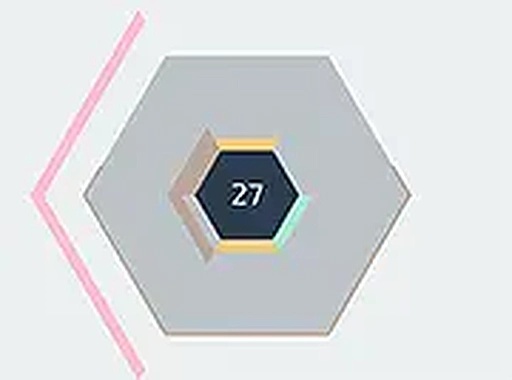
Unlike grid-based puzzlers, Triple Hex Color Match centers on a single hexagon that you rotate. Each of its six faces holds a stack of colored blocks. Blocks fall from the edges, and your job is to turn the hexagon so incoming blocks land on faces where their color already exists. This adds a spatial planning layer: you are not just reacting to what falls, but deciding which face to expose next. [IMG_1]
To clear a stack, you need three or more blocks of the same color on one face. When that threshold is met, the stack vanishes and frees space. But blocks keep coming, and the fall speed increases. Neglect a face and its stack can exceed the safe zone, marked by a grey boundary, ending the run. The tension comes from juggling multiple stacks: clear the wrong one and you may leave another vulnerable. Thinking two or three moves ahead is essential. [IMG_2]
The interface is minimalist. A clearly outlined hexagon sits in the center, with the safe zone visible as a grey ring. Blocks are brightly colored and distinct, so you can read the board at a glance. Rotation is smooth and responsive whether you use a mouse on desktop or touch on mobile. A full-screen mode is available, though the game works fine in a standard window. No installation or account is required—it runs directly in a web browser.
Regular play can sharpen spatial awareness and reaction time. Because difficulty escalates and there is no set endpoint, each session becomes a personal challenge to beat your previous record. The combination of color matching and rotation provides a mental workout that stays engaging without needing story or progression systems.
Sign in to comment
You must be logged in before posting a review or rating.
No comments yet. Be the first to comment!





Editorial Notes