 ArrowWord Games
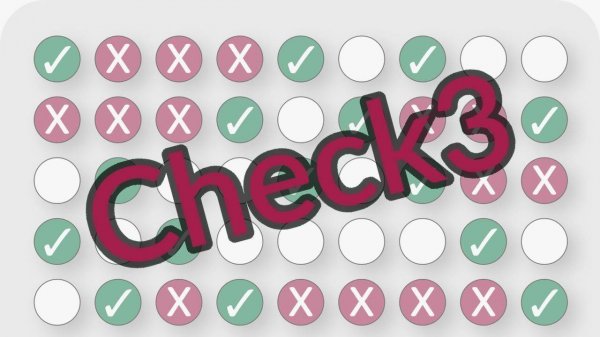
Grid Deduction: Three Per Line takes a single constraint and builds a complete puzzle system around it. The requirement that every row and column hold exactly three non-adjacent marks creates genuine multi-step reasoning, and the cross-placement tool keeps deductions visible. The absence of timers or scores makes it approachable for families and casual players, while larger or clue-sparse grids offer enough challenge for experienced solvers. The main limitation is inherent to the concept: players seeking action, narrative, or rapid feedback will find it too quiet.
Grid Deduction: Three Per Line builds its entire challenge around one constraint: every row and every column must end up with exactly three marks. The restriction that no two marks may share a side horizontally or vertically turns a simple counting task into a spatial reasoning problem. A placement in one corner can rule out squares several rows away, so players learn to evaluate the board as a connected system rather than a series of independent lines.
To manage that complexity, the game lets players place crosses on squares that cannot hold a mark. Crosses are not decorative; they record eliminated possibilities so the remaining viable spots stand out. As the grid fills with crosses, the board shifts from a blank slate into a visible map of logical certainties. This mirrors the pencil-and-paper technique of marking off impossible cells, but in a clean digital format that keeps the focus on reasoning.
There is no timer and no score pressure, so each puzzle can be solved at whatever speed suits the player. That design supports short mental breaks as well as longer focused sessions. The interface stays straightforward, with no distracting animations or clutter, which keeps attention on the grid itself. The family-friendly presentation makes it easy to pass a device between players or work on a puzzle together.
The core rule never changes, but puzzles differ in grid size and how many marks or crosses are provided at the start. Some grids include a few pre-placed marks or crosses that act as a gentle entry point. Others require deduction from scratch with little or no initial help. This variation keeps the experience fresh without adding new rules, and each completed puzzle feels earned through careful reasoning rather than speed or guesswork.
Sign in to comment
You must be logged in before posting a review or rating.
No comments yet. Be the first to comment!




Editorial Notes