 ArrowWord Games
Tidy Fit Logic Challenge appeals to players who enjoy jigsaw-style spatial reasoning without time pressure. Its strength is the gradual difficulty ramp: early levels teach placement rules, while later ones tighten space and add awkward shapes. The lack of scoring or fail states keeps the tone meditative, though players seeking competition or fast action may find it too quiet.
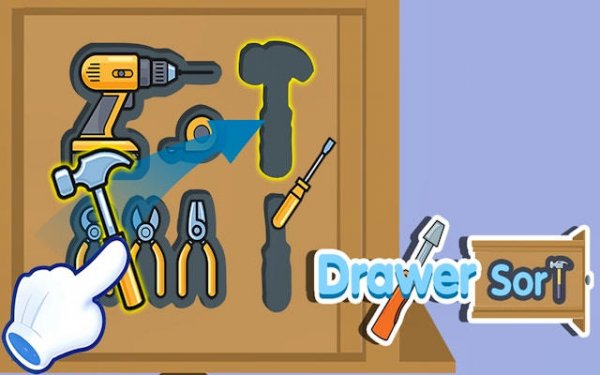
Each puzzle in Tidy Fit Logic Challenge presents a drawer containing objects of different shapes and sizes. The goal is straightforward: place every item so nothing overlaps and the arrangement fits snugly. The challenge comes from the fact that one misplaced object can block the rest of the solution, so players need to think several steps ahead rather than placing items at random.
Early levels use basic shapes and leave plenty of open space, which gives new players room to learn the controls and the basic rules. Later puzzles tighten the available area, introduce irregularly shaped items, and increase the number of objects that must fit. The result is a steady ramp that stays approachable while still demanding sharper spatial reasoning as players continue.
Success depends on surveying the full set of items before making a move. The most restrictive objects—usually the largest or the most awkwardly shaped—are best placed first, because they consume the least flexible space. Smaller items can then fill the gaps that remain. This order of operations rewards patience and forethought, and it trains players to analyze spatial relationships instead of relying on trial and error.
The game uses clean, uncluttered visuals with subtle color coding that helps players tell items apart without distraction. Drag-and-drop controls work on both touchscreens and desktop setups, and placement feedback is immediate. There is no timer, no penalty for taking time, and no fail state beyond an arrangement that cannot be completed. That design supports short breaks as well as longer, focused sessions.
Sign in to comment
You must be logged in before posting a review or rating.
No comments yet. Be the first to comment!





Editorial Notes