 ArrowWord Games
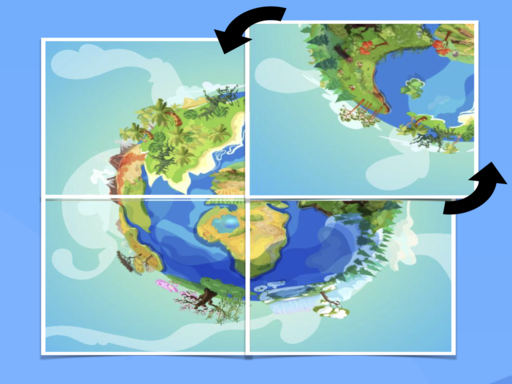
Picture Grid Puzzle strips the visual puzzle down to one clean mechanic: click a tile, rotate it, and watch the image reassemble. The absence of timers and scores removes the usual stress of casual games, making it a good fit for short breaks or low-key evening play. The 2x2 to 5x5 range gives beginners and experienced solvers a reason to stay. Its main limitation is that the core loop never changes; once you understand rotation, the challenge comes only from grid size and image complexity. Players who want progression systems or competitive elements will find it too simple. Those seeking a quiet, family-friendly brain teaser will get exactly what the description promises.
Picture Grid Puzzle takes a finished image, slices it into square tiles, and rotates each tile to a random orientation. Your only action is clicking a tile to rotate it one step. There are no drag-and-drop mechanics, no piece swapping, and no hidden controls. The entire challenge rests on recognizing when a tile's edges, colors, and patterns align with its neighbors. Because every click is reversible and costs nothing, you can experiment without penalty. The puzzle rewards observation over speed.
Before each round, you pick a grid size. A 2x2 layout gives you four tiles and a quick warm-up. The 5x5 option spreads the image across twenty-five tiles, turning a simple rotation task into a test of patience and visual memory. Larger grids multiply the number of possible orientations per tile, so the same core mechanic scales naturally from a two-minute break to a longer focused session. There is no locked progression; you select the difficulty that matches your available time and attention.
No countdown appears when you start. No score tally sits in the corner. The game omits timers, move limits, and star ratings entirely, which changes how you approach each puzzle. Instead of racing to beat a clock, you can study the image, test a rotation, and reverse it if the result looks wrong. That design makes Picture Grid Puzzle suitable for winding down after work or for a short mental reset between tasks. The clean interface keeps the image itself as the only focal point.
Each rotation animates smoothly, so you always see the tile move from its old angle to its new one. That feedback matters on larger grids, where tracking which tiles you have already corrected becomes part of the challenge. The game runs in a browser on both desktop and mobile, and new images are added over time to keep the puzzle library from growing stale. There are no downloads, no account requirements, and no content that would be out of place for younger players.
Sign in to comment
You must be logged in before posting a review or rating.
No comments yet. Be the first to comment!





Editorial Notes